123 W. Willow Street Chippewa Falls, WI 54729


If your gums bleed when you brush, feel sore, or look somewhat puffy — that’s not the kind of thing to ignore. They are early warnings that your gum health might be changing. And the good news? If caught early, gum disease is highly manageable.
This blog will take you through the stages that lead to gum disease, what can happen at each stage, and why it’s best to act sooner rather than later.
What Is Gum Disease, Really?
Gum disease is an infection of the tissues supporting your teeth. It begins when a sticky film of bacteria accumulates along the gumline. When plaque isn’t cleared through regular brushing and flossing, it hardens into tartar. At that stage, a toothbrush cannot clean it.
It’s more frequent than most people realize. According to the CDC, almost half of U.S. adults over 30 have some form of gum disease. Just like anywhere else, in Chippewa Falls, WI, daily life can get busy, making early signs of dental problems easy to miss.
The difference between a cleaning and periodontal disease treatment in Chippewa Falls is recognizing the need for proper care before it becomes complicated.
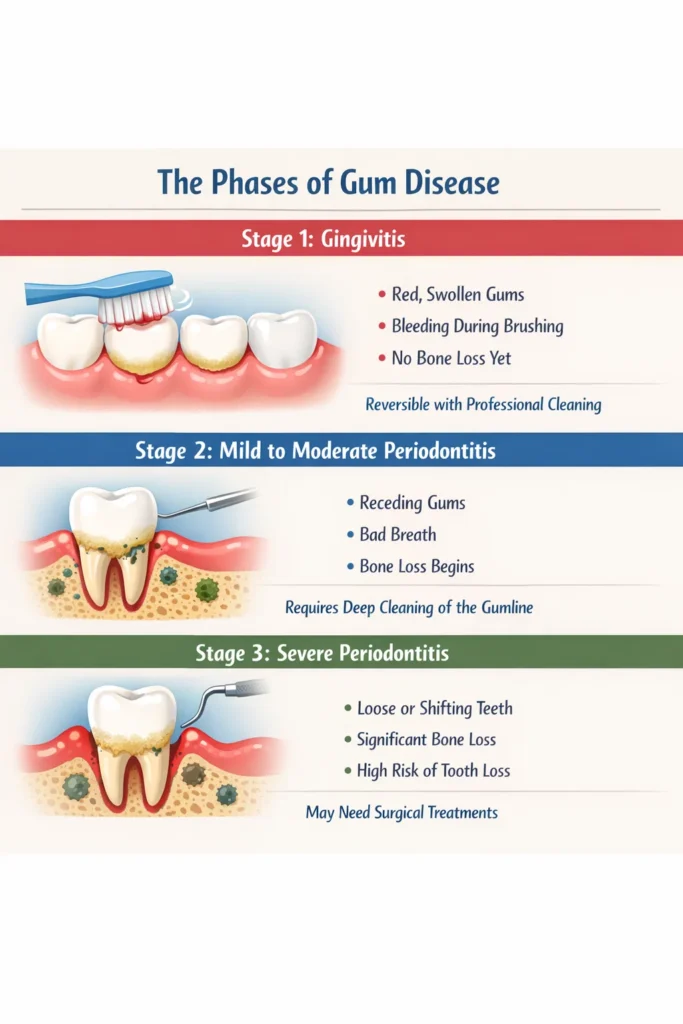
The Phases of Gum Disease
Stage 1: Gingivitis
This is the earliest and only fully reversible stage.
- Gums appear red or swollen
- Bleeding during brushing or flossing
- No bone loss has occurred yet
- No pain in most cases
At this stage, it usually takes a professional cleaning and better oral hygiene at home. The damage is not very serious yet.
Stage 2: Mild to Moderate Periodontitis
If gingivitis goes untreated, the infection advances below the gum line. Spaces develop between the teeth and gums where bacteria gather.
- Gums may begin to recede from the teeth
- Persistent bad breath that doesn’t go away
- X-rays show slight bone loss
- Increased sensitivity possible
This stage requires a procedure called scaling and root planing — a deep cleaning of buildup below the gumline and smoothing the root surface so the gums can reattach.
Stage 3: Severe Periodontitis
By this time, there is considerable loss of bone and tissue. This phase is irreversible but can be treated.
- Teeth may feel loose
- Gums have receded noticeably
- Chewing may become uncomfortable
- It becomes a very real risk of tooth loss
Surgical options, such as bone grafting or tissue regeneration procedures, may be performed here. The objective becomes less reactive and more stabilizing, a preservation.
Can Gum Disease Be Reversed?
- Gingivitis: Yes, completely. With appropriate treatment and a professional cleaning, gum tissue can heal completely.
- Mild to Moderate Periodontitis: Somewhat. It can be controlled, and its progression prevented. Damaged bone or tissue won’t regenerate fully on its own, but the condition can be stabilized effectively.
- Severe Periodontitis: Managed, not reversed. More advanced cases require ongoing maintenance and occasional surgical procedures. The use of bone grafts or regenerative procedures can help restore some architecture, but early periodontal disease treatment in Chippewa Falls is always better.
Treatment Options at Each Stage
- Professional Cleaning (Prophylaxis): Used for the treatment of gingivitis. Completed as part of a routine dental visit. Cleans between teeth around the gingival margin.
- Scaling and Root Planing: A non-surgical deep cleaning for early to moderate periodontitis. Typically performed in sections under local anesthesia. Most patients tolerate it well.
- Antibiotic Therapy: Sometimes in conjunction with deep cleaning. May be topical (applied directly in gum pockets) or oral. Aids in eliminating bacteria that brushing cannot access.
- Surgical Treatments For Advanced Cases: Includes flap surgery, bone grafts, or guided tissue regeneration. Restores structure where significant damage has occurred.
- Maintenance Periodontal Maintenance: Patients return for periodic maintenance every 3–4 months after treatment, rather than 6 months. It maintains low bacterial levels and measures gum pocket depth over time.
Simple Things That Make A Difference Between Visits
- Use a soft-bristle toothbrush to brush at least twice a day.
- Floss once a day — this removes what brushing leaves behind
- If your dentist recommends an antibacterial mouthwash, use it.
- Don’t smoke — it makes gum disease worse.
- If you have diabetes, manage blood sugar (it’s connected with gum health)
- Stay consistent with dental checkups.
These aren’t complicated habits. But they always do help with outcomes, particularly for people who have been diagnosed with gum disease.
Get The Next Step: Your Gum Health Matters
Whether you’ve seen early warning signs or haven’t been to a checkup in ages, now is as good a time as any to get clarity on where your gum health stands.
At Willow Street Dental, our dentist, Dr. Curtis Calder, is dedicated to providing comprehensive periodontal disease treatment in Chippewa Falls for patients. Whether it’s routine cleanings or advanced periodontal care, we provide the services you need with your comfort in mind.
Book your appointment today. Call our dental office or visit willowstreetdental.com to schedule.
Common Questions Most People Ask
How do I know if I have gum disease?
Common signs include bleeding gums, bad breath, gum recession, and tooth sensitivity. A dental exam with X-rays gives a clear picture.
Is gum disease painful?
Not always — especially in early stages. Many people have it without realizing it. That’s why regular checkups matter.
Can gum disease cause tooth loss?
Yes. Advanced periodontitis is a leading cause of tooth loss in adults. Early treatment greatly reduces that risk.
How long does scaling and root planing take?
Typically 1–2 appointments, depending on severity. Each session covers a portion of the mouth.
Related Articles